Building a Strong Organisational Culture: A Framework Rooted in Values, Trust, and Ubuntu

Dr Jumoke Aleoke-Malachi
Thu Jan 29 2026 · 5 min read
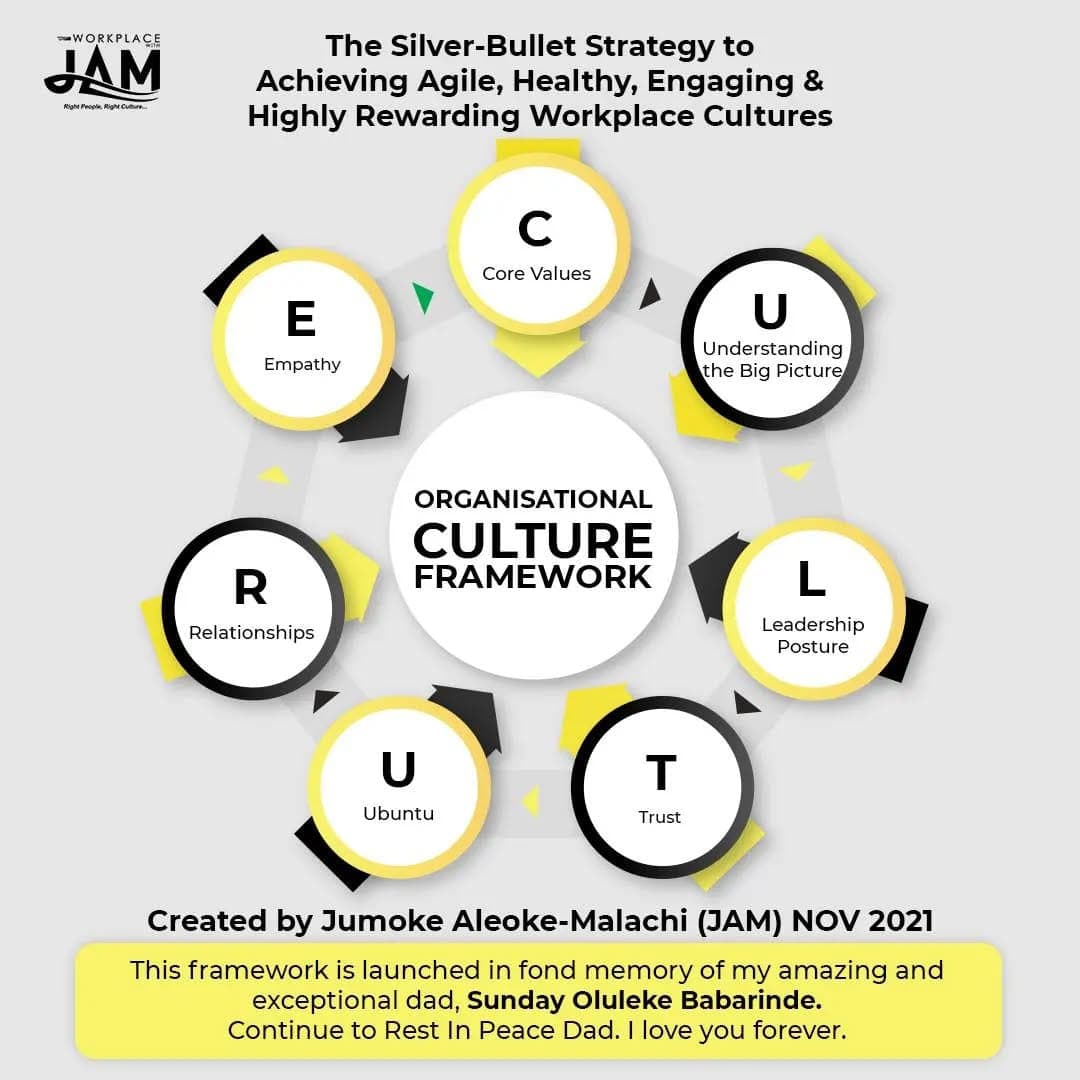
Organisational culture becomes real not in theory, but in practice—through everyday choices, leadership behavior, and how people relate to one another. Across Africa and Nigeria, many organisations have demonstrated that culture rooted in core values, shared purpose, trust, Ubuntu, relationships, and empathy can drive sustainable success even in complex environments.
This section presents case-study style examples that illustrate how these cultural pillars show up in real organisational contexts.
Case Study 1: Core Values in Action
Dangote Group (Nigeria)
Cultural focus: Core values, discipline, accountability
The Dangote Group is known for its strong emphasis on discipline, excellence, and long-term value creation. These values are consistently reinforced through leadership expectations, operational standards, and performance management systems.
What stands out culturally:
- Decisions prioritize long-term impact over short-term gains
- Strong accountability structures across subsidiaries
- Clear expectations around work ethic and responsibility
Cultural lesson:
When core values are consistently enforced—not just communicated—they shape behavior across large, complex organisations.
Case Study 2: Understanding the Big Picture
MTN Group (Africa-wide)
Cultural focus: Shared purpose, alignment
MTN operates across multiple African countries with diverse cultures and markets. Its guiding purpose, “Leading digital solutions for Africa’s progress,” helps employees understand how their roles contribute to broader social and economic development.
What stands out culturally:
- Employees connect telecom services to national development
- Strategy communication is simplified and repeated
- Local teams align daily work with regional and continental goals
Cultural lesson:
When people understand the big picture, alignment improves even across borders and cultures.
Case Study 3: Leadership Posture
Access Bank (Nigeria)
Cultural focus: Leadership posture, service-oriented leadership
Access Bank’s growth strategy has been supported by a leadership culture that emphasizes mentorship, professionalism, and emotional intelligence. Leaders are expected to model the values they promote.
What stands out culturally:
- Leaders are visible and accessible
- Strong investment in leadership development
- Emphasis on succession planning and talent growth
Cultural lesson:
Leadership posture sets the tone—people imitate what leaders consistently demonstrate.
Case Study 4: Trust as an Organisational Accelerator
Flutterwave (Nigeria / Africa)
Cultural focus: Trust, empowerment
Flutterwave operates in a fast-moving fintech environment where innovation depends on speed and autonomy. Teams are trusted to make decisions, experiment, and take ownership.
What stands out culturally:
- High level of autonomy for teams
- Rapid decision-making
- Strong ownership mindset
Cultural lesson:
Trust reduces bureaucracy and enables innovation, especially in dynamic industries.
Case Study 5: Ubuntu in Organisational Culture
Safaricom (Kenya)
Cultural focus: Ubuntu, collective success
Safaricom’s internal culture reflects the African philosophy of Ubuntu—recognizing that success is shared. Employees are encouraged to collaborate, support one another, and see themselves as part of a larger community.
What stands out culturally:
- Strong emphasis on teamwork
- Community-focused initiatives
- Internal culture aligned with social impact
Cultural lesson:
Ubuntu strengthens belonging and reinforces the idea that organisational success is collective, not individual.
Case Study 6: Relationships as Cultural Infrastructure
Guaranty Trust Bank (GTBank), Nigeria
Cultural focus: Relationships, respect, professionalism
GTBank is widely recognized for its strong internal and external relationships. The organisation emphasizes professionalism, respect, and consistency in how people interact—with colleagues and customers alike.
What stands out culturally:
- Strong internal communication standards
- Consistent service culture
- High levels of employee pride and loyalty
Cultural lesson:
Strong relationships create stability, brand trust, and long-term performance.
Case Study 7: Empathy and Human-Centered Leadership
Andela (Africa / Global)
Cultural focus: Empathy, people development
Andela built a culture centered on talent development, learning, and inclusion. Leaders were trained to understand individual growth paths and support employees beyond immediate output.
What stands out culturally:
- Emphasis on learning and feedback
- Flexible work arrangements
- Strong sense of belonging across regions
Cultural lesson:
Empathy increases engagement, retention, and long-term organisational resilience.
Bringing It All Together: An African-Centered Culture Framework
Across these examples, a clear pattern emerges:
- Core values guide decisions
- Big-picture understanding drives alignment
- Leadership posture shapes daily behavior
- Trust enables speed and innovation
- Ubuntu fosters collective success
- Relationships sustain collaboration
- Empathy humanizes performance
African and Nigerian organisations demonstrate that strong culture is not imported—it is built from context, values, and people.
Case Study 8: Innovation, Trust, and Empathy in a Traditional Institution
Wema Bank (Nigeria)
Cultural focus: Core values, leadership posture, trust, empathy, understanding the big picture
Wema Bank’s transformation from a traditional commercial bank into a digitally driven institution is a strong example of how intentional culture change can reposition an organisation. Through its digital strategy—most visibly ALAT, Nigeria’s first fully digital bank—Wema Bank redefined how it sees customers, employees, and innovation.
What stands out culturally:
- Understanding the big picture:
Leadership clearly communicated the bank’s long-term vision: staying relevant in a rapidly digitizing financial ecosystem. Employees were encouraged to see digital innovation not as a threat, but as the future of banking. - Leadership posture:
Leaders adopted a forward-looking, learning-oriented posture—supporting experimentation, accepting failure as part of innovation, and encouraging cross-functional collaboration. - Trust and empowerment:
Teams working on digital products were trusted to move fast, make decisions, and challenge traditional banking processes. This reduced bureaucracy and increased ownership. - Empathy and customer-centricity:
ALAT was designed around real customer pain points—ease of access, simplicity, and inclusion—reflecting an empathetic understanding of Nigeria’s diverse banking population.
Cultural lesson:
Wema Bank shows that even long-established institutions can reinvent themselves when leadership aligns values, trust, empathy, and strategic vision into a coherent culture.
Why Wema Bank Matters in This Framework
Wema Bank demonstrates that:
- Culture can be a competitive advantage, not just an internal concept
- Innovation thrives where trust and psychological safety exist
- Empathy drives both customer experience and employee engagement
Its journey reinforces the idea that organisational culture is not static—it evolves when leaders intentionally reshape behaviors, mindsets, and relationships.
Organisational culture is a living system. When culture is intentionally designed around values, trust, Ubuntu, relationships, and empathy, organisations do more than succeed—they endure.